MAB UNESCO
UNESCO MAB Research and Education Network for Slovakia

MAB UNESCO Research and Education Network for Slovakia

The MAB UNESCO Research and Education Network for Slovakia is a national network for research and education in the biosphere reserves of Slovakia, with cooperation extending abroad. The network was established in June 2025 and its partners are the biosphere reserves of Poľana, Slovak Karst, Tatras and Eastern Carpathians, natural science departments/faculties of universities and colleges, and scientific institutions that work in the territories of biosphere reserves.

The vision of the network is to create a unique research and educational community in Slovakia and its mission is to constantly expand cooperation not only among its partners, but also with kindergartens, primary and secondary schools, monuments on the UNESCO World Heritage List, with the Slovak Folk Art Collective operating in the field of artistic processing and interpretation of traditional folk culture in Slovakia and many others, with the Center for Folk Art Production, which fulfills its mission in the field of protection and development of traditional crafts and home-made products in Slovakia and many other partners who are dedicated to culture, traditions and traditional production in the territories of biosphere reserves.

Network partner cooperation:

SV MAB UNESCO thanks all partners for their membership and valuable cooperation.

UNESCO MAB Programme

The MAB Programme is coordinated at the international level by the MAB Secretariat within UNESCO. The governing body is the International Coordinating Council for the MAB Programme (ICC MAB). At the national level, UNESCO activities are coordinated by the Ministry of Foreign and European Affairs of the Slovak Republic (MZVaEZ SR) and through the Slovak Commission for UNESCO (SK UNESCO). The issue of biosphere reserves (BR) is covered by the Ministry of the Environment of the Slovak Republic (MŽP SR).

What are biosphere reserves?

Biosphere reserves are “learning sites for sustainable development”. They are places to test interdisciplinary approaches to understanding and managing change and interactions between social and ecological systems, including conflict prevention and biodiversity management. They are places that provide local solutions to global challenges. Biosphere reserves include terrestrial, marine and coastal ecosystems. Each site promotes solutions that combine the conservation of biodiversity with its sustainable use.

Biosphere reserves are nominated by national governments and remain under the sovereign jurisdiction of the states in which they are located. Biosphere reserves are designated under the intergovernmental MAB programme by the Director-General of UNESCO, based on decisions of the MAB International Coordinating Council (MAB-ICC). Their status is internationally recognised. Member States can nominate sites through a designation process.

Biosphere reserves involve local communities and all stakeholders in planning and management.

Functions of the Biosphere Reserve​

All three basic tasks of BR are given equal importance and are fulfilled in a balanced manner.

Preserving biodiversity and cultural diversity

Economic development that is socio-culturally and environmentally sustainable

Logistical support for development through research, monitoring, education and training

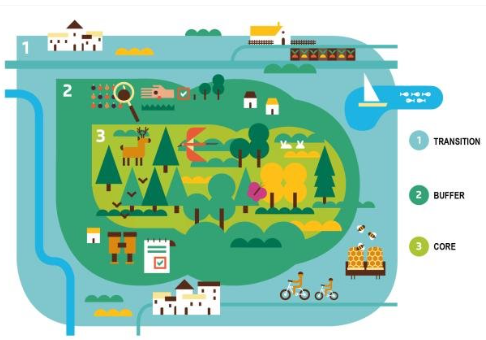
In accordance with the so-called MAB Framework Statutes, BRs should include one or more core zones, a buffer zone and a transition zone, which allow for the differentiated performance of all their functions.

core zone – is a legally established natural or minimally modified area or several areas dedicated only to long-term protection (no-intervention area, only non-invasive scientific research methods are allowed).

B) buffer zone (or zones) – is usually an area surrounding or connecting core zones. However, it can also exist independently of the core zone. Human activities that do not harm conservation objectives are possible in them.


C) transition zone – is an area where sustainable management of natural resources is developed and promoted.

Management of a biosphere reserve should be based on equal, comprehensive cooperation between scientists from natural and social sciences, conservation and development groups, representatives of state administration and self-government, and above all, the local population.